Ruby vs Sapphire vs Emerald: Which Precious Stone Should You Choose?
Ruby, sapphire or emerald? Compare the three precious stones on durability, price, treatment and care to choose the right ring.
·
7 minute read
Ruby, sapphire and emerald are the three precious coloured stones. For centuries they have been the gems of kings, and today they are the first three choices for a man who wants a ring with real colour. They differ more than their shared status suggests: in toughness, in price, in the care they need and in how they look on the hand.
This guide compares the three side by side so you can choose the one that fits your life and your budget.
The short answer
Toughest: ruby and sapphire. Both score 9 on the Mohs scale and suit daily wear.
Most delicate: emerald. Hard but brittle, and best in a protective setting.
Most affordable of the three: sapphire, for a given size and quality.
Most expensive in fine quality: ruby.
Simplest choice: pick the colour you love, then let durability and budget decide the rest.
The three stones compared
Hardness
Usual treatment
Ruby
9
Heat
Sapphire
9
Heat
Emerald
7.5–8
Oil
Birthstones: emerald for May, ruby for July and sapphire for September.
Ruby
Ruby is the red variety of the mineral corundum. Its colour comes from chromium, and the best stones are a pure, vivid red with a soft glow.
Strengths. Extremely hard, holds its polish for decades, and is the rarest of the three in fine quality.
Watch for. Glass-filled and lab-created stones sold as natural. Most natural rubies show small internal marks.
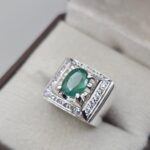
Emerald is the green variety of the mineral beryl. Nothing else has quite the same green, and nearly every natural emerald has visible internal marks known as the garden.
Strengths. A colour no other stone matches, and a long tradition in men’s signet rings.
Watch for. Brittleness. A sharp knock can chip it, and harsh cleaning can draw out the oil used to treat it.
Best for. A ring worn with a little care, in a bezel or signet setting.
Ruby and sapphire are second only to diamond in hardness and have no natural weakness. They resist scratching from everyday dust and survive knocks well. Emerald is hard enough to resist scratches but contains fine internal fractures, so it can chip. If you work with your hands, choose ruby or sapphire.
Price
In fine quality, ruby is generally the most expensive per carat, emerald next and sapphire the most accessible. The ranges overlap widely, because colour, clarity, size and treatment move the price far more than the name of the stone. A good sapphire often gives the largest, cleanest stone for a given budget.
Treatment
Most rubies and sapphires are heated to improve their colour. Most emeralds are oiled to make fine cracks less visible. Both are accepted in the trade when disclosed. Untreated stones of any of the three are rarer and cost more.
Care
Ruby and sapphire need only warm water, mild soap and a soft cloth. Emerald needs the same gentle cleaning and nothing stronger: no ultrasonic cleaners, no steam and no hot water.
Colour and metal
All three look right in sterling silver, which is the traditional metal for men’s gemstone rings. In gold, ruby and emerald gain warmth and richness, while blue sapphire gives a sharper contrast.
How much stone for your money
Budget decides more than most guides admit. For the same amount, the three stones give you different things.
Sapphire usually gives the largest, cleanest stone. Good blue and yellow sapphires are available in generous sizes.
Emerald gives strong colour, but expect visible inclusions unless you pay a good deal more.
Ruby gives the smallest stone of the three in fine colour, because good ruby is the scarcest.
If size on the hand matters to you, start with sapphire. If you want the rarest stone and accept a smaller one, choose ruby.
What to expect in treatment
Almost every stone in a shop has been treated in an accepted way, and a seller should say so without being asked.
Ruby and sapphire are normally heated. Ask whether there is any glass filling or diffusion as well, since both lower the value sharply.
Emerald is normally oiled. Ask how much filler has been used: minor, moderate or significant.
Lab-created versions of all three exist and are real in chemistry. They cost far less and must be sold as lab-created.
Settings that suit each stone
Ruby and sapphire are tough enough for any setting, including open claws that let in the most light. Emerald is safer in a bezel or signet that wraps metal around its edges. For a man’s ring worn daily, a low, protective setting is a sound choice for all three.
Tradition and meaning
All three have marked important occasions for centuries. They are the birthstones for May, July and September, and they are the traditional gifts for the 40th anniversary (ruby), the 45th (sapphire) and the 55th (emerald). Many men simply choose the stone linked to their own birth month or to a date that matters to them.
Three mistakes buyers make
Choosing by name alone. A fine sapphire is a better buy than a poor ruby.
Forgetting how the ring will be worn. An emerald on a hand that does manual work will not stay perfect.
Not asking about treatment. It affects price more than almost anything else.
Which should you choose?
Choose ruby if you want a bold red, the rarest of the three, and a ring that will take daily wear.
Choose sapphire if you want the toughest, most practical choice and the best size for your money.
Choose emerald if green is your colour and you are happy to treat the ring with some care.
If you cannot decide, try this. Picture the ring on your hand at work, at dinner and in ten years. The stone you still want in all three pictures is the right one.
Common questions
Which is the most valuable: ruby, sapphire or emerald?
In the finest qualities, ruby usually commands the highest price per carat, followed by emerald and then sapphire. Individual stones vary so much that any of the three can be the most expensive in a shop.
Which is the most durable?
Ruby and sapphire, equally. They are the same mineral and both score 9 on the Mohs scale. Emerald is softer and more brittle.
Are ruby and sapphire the same stone?
They are the same mineral, corundum. Red corundum is called ruby and every other colour is called sapphire.
Which is best for a man’s ring?
For daily wear, sapphire or ruby. For the richest green and a traditional signet, emerald. See all seven popular stones in our guide to the best gemstone rings for men.
Can I wear all three every day?
Ruby and sapphire, yes. Emerald, yes with care: a protective setting, and off for the gym and manual work.
Is a natural stone always treated?
Not always, but usually. Heating for ruby and sapphire and oiling for emerald are standard. An untreated stone should come with a laboratory report that says so.
Which of the three is the rarest?
Fine ruby is the scarcest, especially in larger sizes. Clean emeralds of good colour are also rare. Sapphire is the most plentiful of the three.
Which gives the best value?
Sapphire, for most buyers. It combines top hardness with the widest choice of size and colour for the money.
Find your stone
Every Gemswears ring is cut and set by hand in our own workshop, in the silver or gold you choose, and delivered free worldwide.