How to Tell if a Ruby Is Real Before You Buy: 2026 Guide
How to tell a natural ruby from glass-filled, lab-created and imitation stones, what a lab report proves, and what a ruby ring should cost.
·
8 minute read
A natural ruby is one of the few gemstones that can cost more per carat than a diamond, and that is exactly why so many red stones are sold as ruby when they are something else. The good news is that overpaying is easy to avoid. You need to know what you are being offered, what it should cost relative to the alternatives, and which questions make a dishonest seller uncomfortable.
This guide explains the five kinds of stone sold as ruby, the checks you can do yourself, what a laboratory report tells you, and what drives the price of a ruby ring.
The short answer
Know the type. Natural untreated, natural heated, glass-filled, lab-created and imitation stones are all sold as ruby. Their prices differ enormously.
Heated is normal. Most natural rubies are heated. It is accepted in the trade, as long as the seller says so.
Avoid glass-filled ruby unless it is priced as costume jewellery. It is fragile and holds no value.
Look for flaws. Small natural marks under a magnifier are a good sign. A flawless stone at a low price is not.
For an expensive stone, ask for a report from an independent laboratory.
Five stones that are sold as ruby
Every one of these can appear under the word ruby in a listing. Only the first two are what most buyers mean by a natural ruby.
Type
What it is
Value
Untreated natural
Mined, only cut and polished
Highest
Heated natural
Mined, then heated to improve colour
High
Glass-filled
Low-grade ruby held together with glass
Very low
Lab-created
Real ruby grown in a laboratory
Low
Imitation
Garnet, spinel, glass or other red stones
Lowest
Untreated natural ruby
A ruby that came out of the ground with good colour and needed nothing but cutting. These are rare, and a fine untreated stone from a famous source commands the highest prices in the trade. Sellers describe them as unheated or no heat.
Heated natural ruby
Most rubies on the market have been heated to deepen the red and clear cloudy areas. The result is stable and permanent, and the stone is still a natural ruby. Heating lowers the price compared with an equal untreated stone, which makes a heated ruby the sensible choice for most rings.
Glass-filled ruby
This is the one to watch. Poor-quality ruby full of cracks is filled with lead glass until it looks clear and red. It can be a large, bright stone at a tiny price. It is also fragile: household cleaners, a jeweller’s torch and even lemon juice can damage the glass. A seller should call it glass-filled or composite ruby. If a big, clean ruby is offered cheaply, assume this is what it is.
Lab-created ruby
A laboratory ruby has the same chemistry and hardness as a mined one. It is real ruby, but it is not rare, so it costs a fraction of the price. There is nothing wrong with buying one, provided it is sold as lab-created and priced accordingly.
Imitations
Red garnet, red spinel, tourmaline and plain glass have all been passed off as ruby. Garnet is the most common. It is usually a darker, browner red and lacks the glow of ruby. If you like the look, a garnet ring is a fine stone in its own right at an honest price.
How to check a ruby yourself
No home test can prove a ruby is natural. These checks will, however, catch most of the obvious problems before you spend money.
Look inside with a 10x magnifier
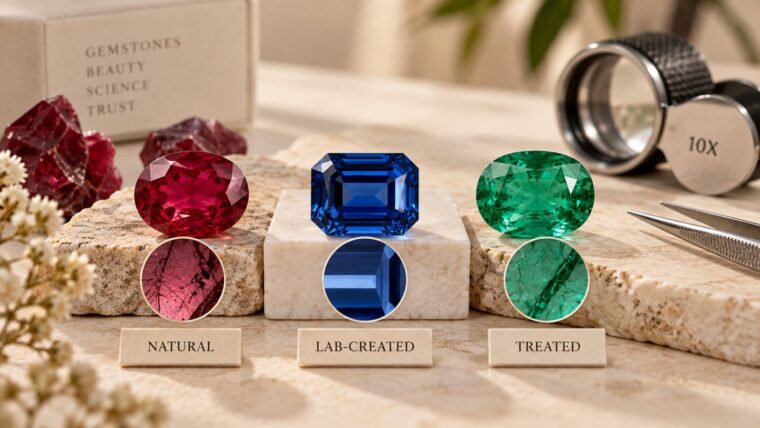
A jeweller’s loupe costs very little and is the most useful tool you can own. Natural rubies almost always contain small marks: fine needles, tiny crystals, fingerprint-like patterns or slight colour bands. Round gas bubbles point to glass or a glass-filled stone. Curved growth lines, like the grooves of a record, point to a lab-created stone. A completely clean interior is possible in a natural ruby, but it is rare and expensive.
Compare the price with the claim
This is the most reliable test of all. A natural ruby of good colour over one carat is costly. If the price is a small fraction of what similar stones sell for elsewhere, the stone is glass-filled, lab-created or not ruby, whatever the listing says.
Look at the colour in daylight
A fine ruby is a strong, slightly glowing red. Too dark and brown suggests garnet. A very even, vivid, almost neon red with no variation at all is typical of lab-created stones. Shop lighting flatters every red stone, so ask to see it near a window.
Tests to skip
You will read about scratching the stone with a coin, rubbing it on glass or breathing on it. Do not rely on them. Lab-created ruby is exactly as hard as natural ruby, so a scratch test proves nothing, and it can damage a stone that is not what you hoped.
What a laboratory report tells you
For any ruby that costs a serious amount, ask for a report from an independent gemmological laboratory. It should confirm three things: that the stone is natural ruby, whether it has been treated and how, and sometimes where it was mined.
The best-known laboratories for coloured stones include GIA, AGL, GRS, SSEF and Gubelin. A certificate printed by the seller is not the same thing. Check that the report number matches the stone and that the weight and measurements agree.
For a modest ruby in a silver ring, a full report can cost a noticeable share of the ring’s price, so it is reasonable to rely on a clear written description from the seller instead: natural or not, treated or not.
What decides the price of a ruby ring
Colour. The biggest factor. A pure, vivid red is worth far more than a pinkish, purplish or dark one. The trade name for the finest red is pigeon blood.
Clarity. Stones with fewer visible marks cost more, but some marks are expected and help show the stone is natural.
Size. Price per carat rises steeply with size. Fine rubies over two carats are rare.
Treatment. Untreated costs most, heated less, glass-filled very little.
Origin. Rubies from Myanmar (Burma) carry a premium. Mozambique is now the main source of fine ruby, and good stones also come from Thailand, Madagascar and Afghanistan.
Metal and making. The same ruby costs much more set in gold than in silver, and hand-made work costs more than cast.
To get the most for your money, choose colour over size. A smaller ruby with a strong red looks better on the hand than a larger pale one, and it costs less.
Six questions to ask before you buy
Is this a natural ruby, a lab-created ruby or another stone?
Has it been heated? Has it been filled with glass or anything else?
Where was it mined, and how do you know?
What is the weight of the stone, separate from the ring?
Is the metal solid silver or gold, or plated?
What is your return policy if a jeweller tells me something different?
An honest seller answers these plainly and in writing. Vague answers are the clearest warning you will get.
Common questions
How can I tell if a ruby is real at home?
Look inside with a 10x magnifier. Small natural marks suggest a natural stone, round bubbles suggest glass, and curved lines suggest a lab-created stone. Then compare the price with similar stones. For certainty, only a laboratory can confirm it.
Is a heated ruby still a natural ruby?
Yes. Heating is a long-established treatment that improves colour and clarity. The stone is still a mined ruby. It should be described as heated and it costs less than an untreated stone of the same quality.
Are lab-created rubies real?
They are real ruby in chemistry and hardness, but they are grown in a laboratory and are not rare. They cost far less than natural rubies and should always be sold as lab-created.
What is a pigeon blood ruby?
It is a trade term for the most valued ruby colour: a pure, vivid red with a slight blue tint and a soft glow. It is a colour grade given by laboratories, not a type of stone, and it carries a large premium.
What is the difference between ruby and garnet?
Ruby is harder, brighter and usually a purer red. Garnet is softer, tends towards a dark or brownish red, and costs much less. A jeweller can tell them apart in seconds with basic instruments.
Why are some ruby rings so cheap?
Because the stone is glass-filled, lab-created or an imitation, or the metal is plated. None of these is a problem if it is stated clearly. It becomes a problem when the ring is described simply as natural ruby.
Is a ruby ring suitable for everyday wear?
Yes. Ruby scores 9 on the Mohs hardness scale, second only to diamond, which makes it one of the best stones for a ring worn daily. See how it compares in our guide to the best gemstone rings for men.
Choose your ruby ring
Every Gemswears ruby ring is cut and set by hand in our own workshop, in the silver or gold you choose, and delivered free worldwide. Ask us anything on the list above before you order.